A Framework for Success
By Derek Powell and Jonae Watts March 2026

Transitioning from military service to civilian employment is a major change for veterans. While veterans bring valuable qualities—such as discipline, leadership, analytical skills, resilience, and a mission-first mindset—the challenge is often translating these strengths into language and behaviors that resonate in the civilian workforce. Employers, workforce agencies, and educational institutions recognize the value veterans offer, but gaps in communication and understanding can prevent these talents from being fully utilized.
This article presents a practical framework to bridge that divide. Organized into four areas—behavioral foundations, hard skills, soft skills, and networking—it offers clear definitions, connects military experience to civilian settings, and provides real-world examples for each area. By adopting this approach, veterans gain a roadmap for articulating their value, and organizations get a tool to unlock leadership, innovation, and resilience within their talent pools. The goal is simple: to ensure that those who served not only transition successfully but also thrive in their next mission.
Why This Framework Matters
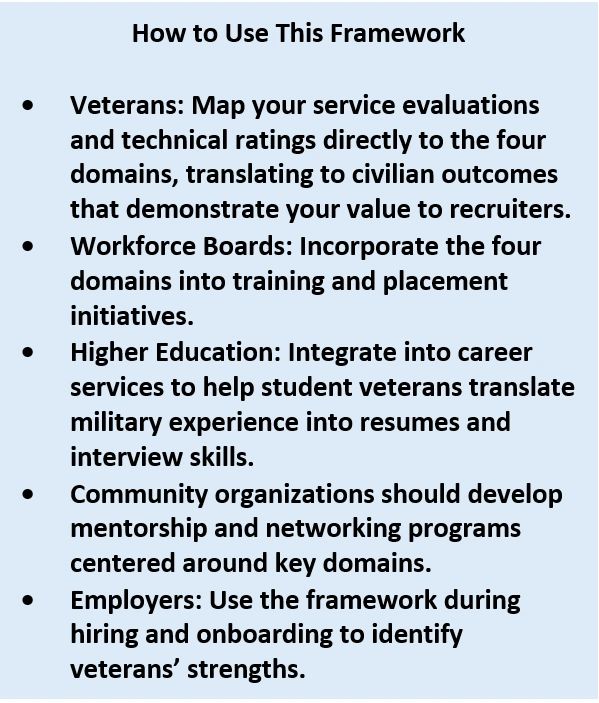
Transitioning from military service to civilian employment often relies more on effective communication than on specific skills. Veterans bring a wealth of experience, discipline, and leadership, but these qualities can be difficult to translate into terms that resonate with employers and educators. To address this, this framework offers a structured approach to bridging the gap between military and civilian worlds. It organizes key career readiness elements into four interconnected areas—behavioral foundations, hard skills, soft skills, and networking—each designed to reflect the depth of military experience while aligning with workforce expectations. By providing clear definitions, practical mappings, and real-world examples, the framework helps veterans highlight their value and enables workforce boards, higher education institutions, community organizations, and employers to recognize and leverage that talent. The result is stronger talent pipelines, greater community impact, and a smoother transition for those who have served.
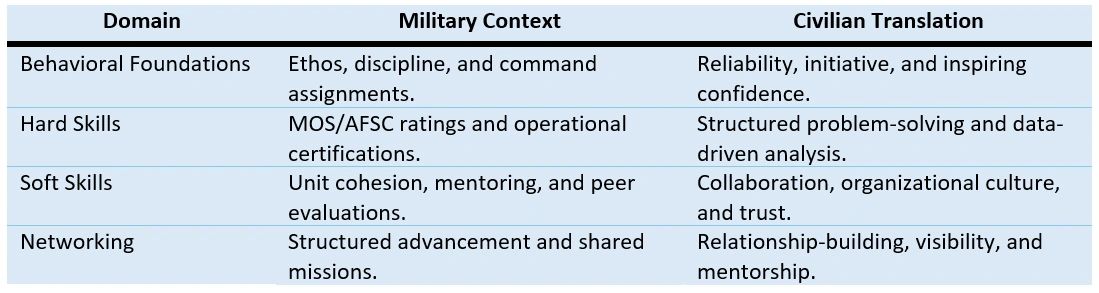
While veterans bring exceptional qualities like discipline and leadership to the workforce, the main challenge is translating these strengths into language that resonates in the business world. To bridge this gap, the framework organizes military experience into four key areas: Behavioral Foundations, Hard Skills, Soft Skills, and Networking. By defining these areas, veterans can see how their service-specific achievements—such as mission planning or unit cohesion—relate directly to high-value civilian roles in fields like strategic planning and team collaboration. The following comparison illustrates how military ethos and technical expertise transition into civilian success.
Behavioral Foundations: The Core Traits That Drive Success
Behavioral foundations are key to professional success and often the most transferable qualities veterans bring to civilian careers. These include discipline, leadership, analytical rigor, and resilience—traits developed in environments that demand precision, accountability, and adaptability. Despite their strengths, veterans may still encounter challenges during the transition. For instance, an emphasis on rigid hierarchy can clash with collaborative corporate cultures, or a tendency toward perfectionism may hinder progress in fast-paced settings. Others might struggle to express these qualities without resorting to military jargon, which can cause employers to overlook their actual value. Reframing begins with translating behaviors into civilian language, seeking feedback to refine leadership styles, and balancing rigor with flexibility. By doing so, veterans can showcase these attributes as assets that enhance performance and foster innovation in any organization.
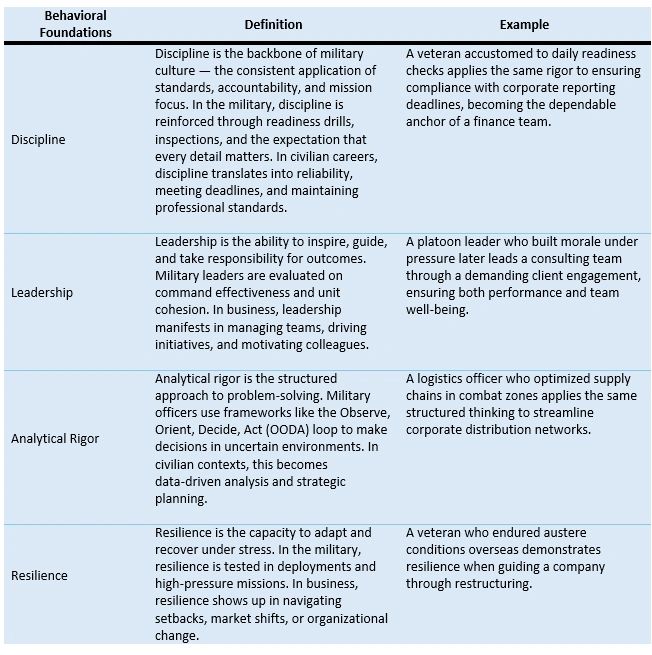
A veteran applying for a project management role can demonstrate discipline by consistently following the application process and communicating promptly with recruiters. Leadership is shown by sharing examples of guiding diverse teams toward successful goals, often through cross-functional collaboration. Analytical rigor is demonstrated through structured problem-solving techniques—such as using data to prioritize tasks or improve workflows—while resilience is shown by explaining how previous experiences prepared them to handle ambiguity and setbacks in dynamic business environments. These behaviors not only enhance a résumé but also demonstrate the candidate offers reliability, adaptability, and strategic thinking for the role. Other qualities a veteran may want to highlight include work ethic, maturity, decision-making, prioritization, accountability, flexibility, interests, and intellectual curiosity.
Hard Skills: Translating Technical Expertise into Business Impact
Hard skills are technical and cognitive abilities that veterans develop through intensive training and operational experience. These include problem-solving, research, analysis, and storytelling—skills that support decision-making and execution in high-pressure situations. However, veterans often encounter difficulties translating these skills into civilian roles. Common mistakes involve using military-specific language without adapting it for business contexts, underestimating the importance of storytelling when presenting technical work, or failing to demonstrate measurable impact in terms employers recognize. Strategies to address this include translating military processes into civilian language, focusing on outcomes rather than procedures, and communicating in a way that connects technical skills to organizational goals. By reframing these abilities for civilian audiences, veterans can showcase their capacity to foster innovation, guide strategy, and communicate effectively in any professional environment.
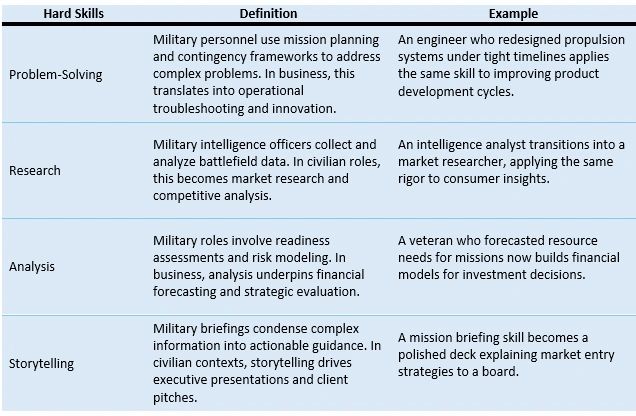
When pursuing a corporate role, a veteran can strategically apply these hard skills. For example, problem-solving is demonstrated by explaining how they tackled complex challenges under tight deadlines, framed as operational efficiency or process improvement. Research skills can be highlighted through experience gathering intelligence using primary or secondary methods and applying it to market analysis or customer insights. Analytical skills are demonstrated through the development of financial models and the assessment of risk scenarios. Meanwhile, storytelling appears in interviews and presentations—turning technical achievements into compelling narratives that demonstrate business impact. By including these elements in résumés, cover letters, and conversations, veterans present themselves as adaptable professionals who combine structured thinking with effective communication to achieve results. Other hard skills include data interpretation, process improvement, risk management, technical writing, digital literacy, and budgeting and resource allocation.
Soft Skills: Building Interpersonal Strengths for Collaborative Success
Soft skills are interpersonal and organizational abilities that enable professionals to work effectively with others, communicate clearly, and build trust—qualities veterans often excel at due to their experience in high-pressure, team-oriented environments. These skills include communication, project management, teamwork, client relationships, quality control, and confidentiality. While these skills transfer well to many settings, veterans may face challenges such as relying too much on directive communication, struggling to adapt from hierarchical to more flexible corporate environments, or failing to see the importance of relationship-building beyond just completing tasks. To overcome these challenges, veterans can practice active listening, adjust their leadership styles to be more collaborative, and focus on empathy alongside accuracy. By viewing these skills as connected to business outcomes—like improved team performance, higher client satisfaction, and more efficient operations—veterans can showcase their ability to succeed in fast-paced, people-focused workplaces.
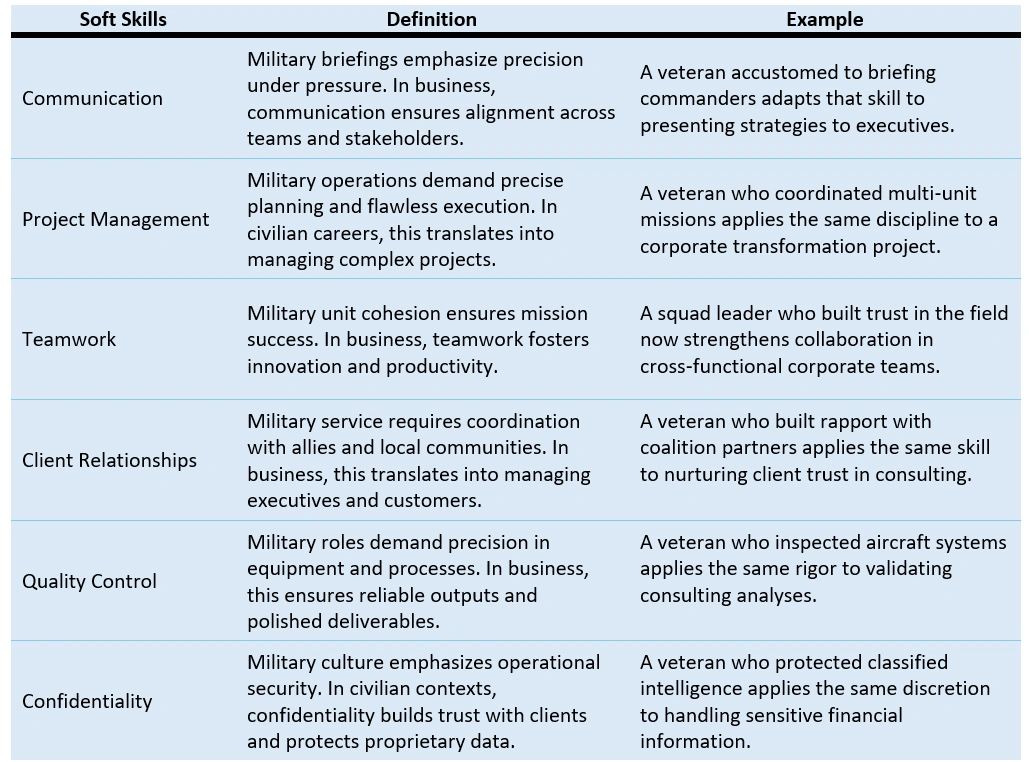
During a job search or career advancement, these soft skills can serve as strong differentiators. For example, communication skills can be demonstrated in interviews by clearly explaining complex experiences in relatable ways. Meanwhile, project management skills can be highlighted through examples of coordinating multi-unit efforts, reframed as managing cross-functional initiatives. Teamwork and client relationship skills become evident when describing collaboration with diverse stakeholders or building trust in challenging situations. Quality control and confidentiality can be presented as commitments to excellence and integrity—key values for roles in consulting, finance, or operations. Incorporating these examples into résumés, cover letters, and networking conversations, veterans show they bring not only technical skills but also the interpersonal flexibility needed to lead and contribute effectively to civilian organizations. Other soft skills include emotional intelligence, conflict resolution, adaptability, negotiation, and cultural competence.
Networking: Expanding Influence and Creating Opportunity
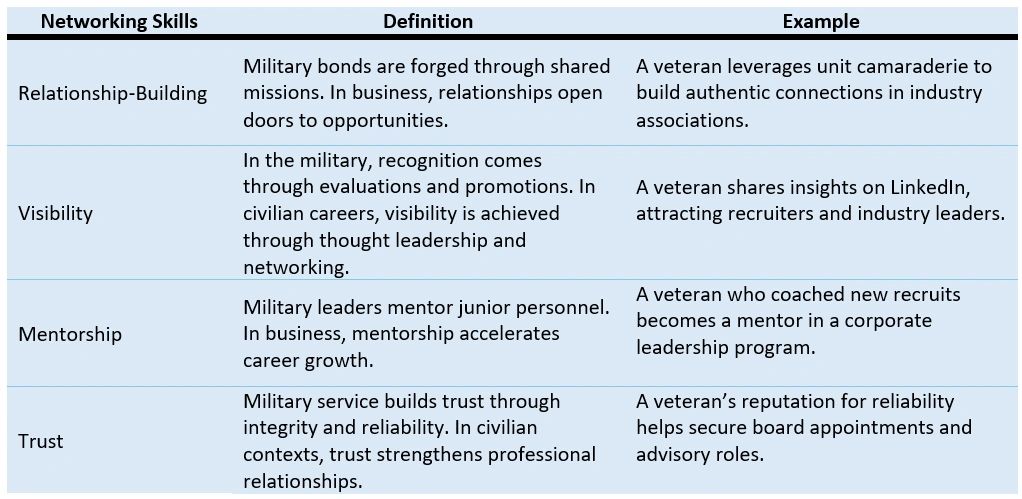
Networking is often the most unfamiliar yet essential part of career success for veterans transitioning into civilian roles. While military service fosters strong bonds through shared missions and trust, professional networking in business requires proactive relationship-building, increasing visibility, seeking mentorship, and establishing credibility. Common pitfalls include undervaluing networking, relying solely on formal job applications, or feeling uncomfortable with self-promotion. Veterans may also struggle to turn their achievements into stories that resonate in professional settings. Strategies for improvement involve viewing networking as mission-focused—building alliances to reach shared objectives—while utilizing platforms like LinkedIn, attending industry events, and seeking mentors for guidance. By approaching networking deliberately and with a goal in mind, veterans can create more opportunities, accelerate career advancement, and strengthen their influence in new environments.
Conclusion
Veterans possess a unique blend of discipline, technical skills, interpersonal strengths, and—when nurtured—strong networks. These qualities, sharpened in high-pressure environments, are highly valued in today’s workforce. This framework offers a practical guide for translating military experience into civilian success, helping veterans effectively communicate their value and enabling employers to fully leverage their potential. By adopting this structured approach, we not only honor their service but also tap into a wealth of talent that fosters innovation, resilience, and leadership across various industries.
Call to Action
• Veterans: Lead your next mission by using this framework to showcase your strengths and build meaningful connections.
• Job placement agencies and workforce boards: Incorporate these principles into your programs to better prepare veterans for competitive roles.
• Employers: Look beyond résumés and recognize the depth of skills veterans bring—invest in their growth and include them in leadership development.
Together, we can turn transition into triumph, ensuring those who served in uniform continue to lead and succeed in their civilian careers.
Supporting Veterans from Marginalized Communities: An Equity-Centered Transition Lens
While all veterans face challenges transitioning into the civilian workforce, those from marginalized communities—including veterans of color, women veterans, LGBTQ+ veterans, disabled veterans, justice-impacted veterans, and veterans from low-income or unhoused backgrounds—often encounter additional systemic barriers. These can include implicit bias, limited access to professional networks, credentialing inequities, unrecognized military experience, gaps in digital literacy, or the combined effects of trauma and economic hardship. Without intentional strategies, these barriers can weaken even the strongest military skills.
This framework should be implemented with a veteran-centered and practical approach, ensuring that transition supports acknowledge individual experiences while broadening access to services, opportunities, and informed choices. The goal is not remediation but alignment—connecting veterans’ strengths to civilian systems that have not always been structured around military experience.
Key Principles for an Inclusive Transition Framework
1. Cultural Translation and Psychological Safety
Veterans from marginalized communities may be navigating environments where they are underrepresented or misunderstood. Creating psychological safety—spaces where veterans can ask questions, practice civilian language, and receive feedback without judgment—is essential. Workforce professionals and educators should avoid deficit-based assumptions and instead focus on strengths, adaptability, and leadership developed through service.
2. Trauma-Informed Career Navigation
Many veterans carry visible or invisible trauma related to combat, discrimination, military sexual trauma, or systemic inequities experienced during and after service. Using trauma-informed practices—such as transparency, choice, consistency, and empowerment—helps veterans engage more fully in career exploration, interviews, and training without re-traumatization.
3. Expanded Definitions of Professionalism and Leadership
Traditional civilian norms around communication, self-promotion, and networking may clash with veterans’ cultural values or military conditioning. This is especially true for veterans from communities where humility, collective success, or survival-driven decision-making were essential. The framework promotes redefining professionalism to include authenticity, community impact, adaptability, and service-focused leadership.
4. Access to Social Capital and Networks
Marginalized veterans often lack inherited or informal professional networks that facilitate entry into civilian careers. Intentional mentorship, cohort-based programs, veteran affinity groups, and employer partnerships are essential for closing this gap. Networking should be taught as a skill—not assumed as prior knowledge—and presented as mission-aligned relationship-building rather than self-promotion.
Applying the Four Domains Through an Equity Lens
· Behavioral Foundations:
Veterans may need help reframing behaviors formed by survival, hierarchy, or bias into strengths like situational awareness, accountability, boundary-setting, and ethical leadership.
· Hard Skills:
Workforce systems should help veterans convert military training into civilian-recognized credentials, certifications, or credit-for-prior-learning pathways—especially for those who lacked access to higher education before service.
· Soft Skills:
Communication and teamwork should be understood within different cultures and environments. Veterans benefit from coaching that affirms diverse communication styles while assisting them in adapting to civilian workplaces expectations.
· Networking:
Equitable networking strategies include warm introductions, sponsored opportunities, paid internships or apprenticeships, and community-based partnerships that decrease dependence on informal gatekeeping.
Role of Systems and Institutions
To strengthen veteran talent pipelines, workforce boards, higher education institutions, community-based organizations, local chambers of commerce, and employers must share responsibility for removing structural barriers.
This includes offering accessible and practical services, training staff to support veteran transitions effectively, investing in supportive services (transportation, technology, childcare, housing stabilization), and monitoring outcomes disaggregated by population to ensure no veteran is left behind.
Another essential agency that supports individuals with both physical and mental health disabilities—including conditions like PTSD—is the Department of Rehabilitation (DOR). DOR plays a vital role in helping veterans with physical, mental, or cognitive disabilities prepare for, find, and keep competitive employment through vocational counseling, training, workplace accommodations, assistive technology, and employer engagement under WIOA Title IV. Despite these available services, vocational rehabilitation is still greatly underused by veterans. Nationwide, while millions of veterans report service-connected or other disabilities, only about 125,000 veterans each year participate in the VA’s Veteran Readiness and Employment (VR&E) program.¹ Only some veterans served by state DOR agencies are identified or connected through veteran-specific pathways. This gap is mainly caused by limited awareness, complicated eligibility processes, poor coordination during transition, and inconsistent referrals among Transition Assistance Programs (TAP), workforce centers, non-profit veteran employment programs, and rehab agencies—highlighting a significant opportunity to better connect DOR with veteran transition and workforce systems so more veterans can benefit fully from these employment supports.
Footnote:
¹ U.S. Department of Veterans Affairs. Veteran Readiness and Employment (VR&E) Program, Annual Budget Submissions and Program Data, as cited in Congressional testimony before the U.S. House and Senate Committees on Veterans’ Affairs.
About The Author:
Derek Powell is a senior leader and consultant specializing in media technology, environmental compliance, and AI-driven supply chain management. His career began in the U.S. Air Force, where he worked as a systems engineer on the Delta II Launch Vehicle Program. After earning his MBA, Derek joined Andersen Consulting (now Accenture) and later RiverOne, focusing on supply chain management technology and services to connect trading partners across the electronics industry. He then took on studio leadership roles at Warner Bros. and Sony, managing global content operations and designing technology platforms for media distribution. Subsequently, he returned to consulting with Deloitte and Altman Solon, advising Fortune 500 clients on strategy, operations, and capital markets…. Get to Know Derek